6.6.1 Typical Injector Nozzle Assembly
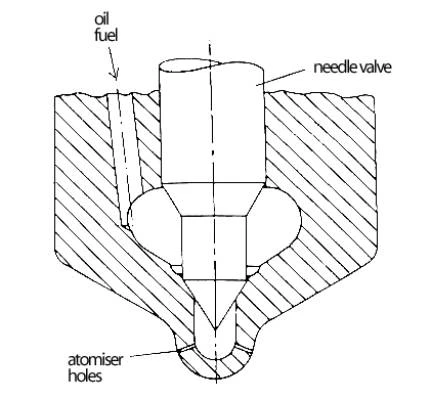
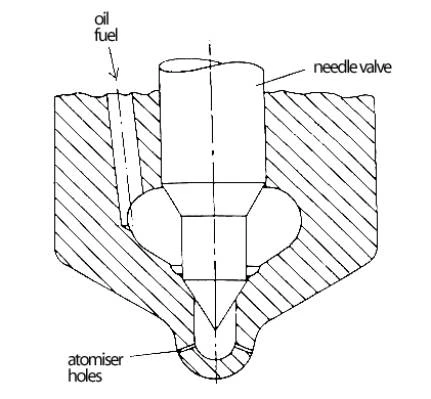
Engines employ a centrally or side-fitted injector with a nozzle tip that is provided with a number of spray holes. The disposition of the holes allows the production of a droplet spray pattern to suit the shape of the combustion chamber.

6.6.2 Atomization Produced by the Injector Nozzle

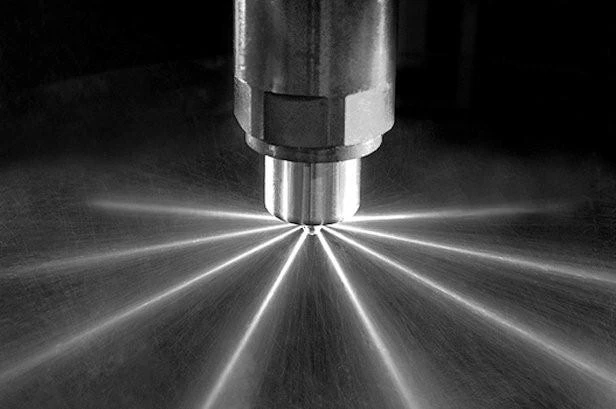
Atomization is the process of disintegrating (separating) fuel into tiny particles, which helps to have a better and even fuel/air mixture. This further helps to absorb heat rapidly to achieve better combustion.
These atomized droplets have a higher surface to mass ratio which helps in good heat transfer from hot compressed air to the oil droplets, resulting in rapid evaporation.
The nozzle has small holes to deliver fuel to the combustion chamber. When fuel enters the engine through the nozzle holes, it gains a high velocity which assists in atomizing the fuel.
6.6.3 Swirl and Penetration: Ignition and Combustion Factors
Efficient combustion of fuel oil inside the engine cylinder is an important aspect for the overall engine efficiency. The process of fuel combustion depends on many processes, which together contribute to engine efficiency.
-
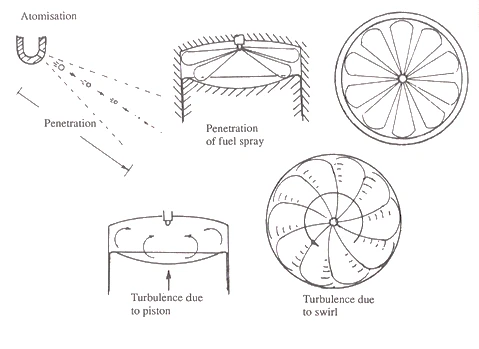
Swirling is the rotating of the fuel/air mixture inside the cylinder.
-
Penetration means the depth the atomized fuel travels in the cylinder. Penetration depends on the size of the atomized particles, their velocities, and the condition inside the combustion chamber.
The fuel that enters the combustion space through the injector nozzle should have a good atomization and penetration effect to mix with the compressed air inside the cylinder.
The compressed air that enters the cylinder should have a swirl effect to properly mix the fuel with air to achieve a better and even fuel/air mixture. This effect is created by the piston profile and scavenge port design (tangentially designed ports).
6.6.4 Care Necessary with Injector Nozzle Holes
The care that must be taken with injector nozzles is significant.
Consequences of Defective Nozzles
Droplets should not impinge on the piston crown, cylinder head, or liner, as this not only reduces performance but may cause local burning of these parts. Unburnt fuel may then be scraped off the liner into the crankcase where it will contaminate the lubricating oil. In addition, a defective fuel injector may cause poor engine emissions.
Nozzle spray holes tend to erode during service with time and depend on fuel quality/condition. This enlargement causes a change in droplet size and possibly in the spray pattern.
Overhauling and Maintenance
Therefore, injectors need to be removed from the cylinder at regular intervals (e.g., MAN-B&W L58/64 engines after 2,000 - 3,000 hours) and cleaning/testing should be carried out.
Overhauling of the injector must be carried out in a place with high cleanliness where dust is minimum. Special attention should be given to the injector nozzle cleanliness.
Cleaning Protocol:
-
When the injector is disassembled, use clean diesel fuel for washing the parts.
-
Disassemble one nozzle at a time to prevent mixing of mating parts.
-
Inspect and clean all parts as they are disassembled. Carbon may be scraped from the outside of the nozzle, but be careful not to damage the edges of the holes.
-
Use the tools provided by the manufacture, such as a cleaning needle, to clean the spray holes carefully, removing only the foreign matters inside the holes.
-
After cleaning is carried out, check the nozzle spray holes size/shape by a go no go gauge to decide the condition of the nozzle holes.
Also, after overhauling, the injector must be well lubricated, covered, and secured in a safe place.